
Boston Criminal History Records
Boston criminal history records come from several sources across Suffolk County, including the Boston Police Department, the Boston Municipal Court, and the Suffolk County Superior Court. As the state capital and the largest city in Massachusetts with about 673,000 residents, Boston has a large court system and multiple ways to search, request, and obtain criminal case files and CORI reports.
Boston Overview
Where Boston Criminal Cases Are Filed
Boston criminal cases are filed across several courts depending on the charge and its severity. Most misdemeanors and lower-level felonies start in the Boston Municipal Court, which has eight divisions spread across the city. The main BMC sits at Edward W. Brooke Courthouse, 24 New Chardon Street, downtown. More serious felony charges go to the Suffolk County Superior Court, also at the Brooke Courthouse. Federal criminal charges are handled at the John Joseph Moakley U.S. Courthouse at 1 Courthouse Way in the Seaport District.
The Boston Municipal Court is one of the only city-specific courts in Massachusetts. It handles arraignments, bail hearings, bench trials, and jury trials for cases arising in the city. Cases can move from BMC to Superior Court when the prosecution seeks an indictment through a grand jury. Suffolk County Superior Court then takes over for the full trial. Both courts maintain docket records that are open to the public unless a judge has sealed them. You can search active and closed case files through the state court portal at masscourts.org at no cost.
Boston Police Department Records
The Boston Police Department maintains arrest records, incident reports, and booking records for events that occur within Boston city limits. The Records Division handles all public requests for these documents.
The Boston Police Department is located at 1 Schroeder Plaza, Boston, MA 02120. You can reach the main line at (617) 343-4500. For records requests specifically, call the Records Division at (617) 343-4420. You can submit requests in person during business hours or by mail. Copies cost $0.50 per page, and most requests take five to ten business days to fill. The BPD website at bpdnews.com has information on how to submit a records request and what forms to use.
Arrest records from the BPD document the date and location of an arrest, the charge or charges, and the arresting officer. These records are separate from court records. An arrest record does not show the outcome of a case. To find out what happened in court, you need to search the court docket through masscourts.org or visit the court clerk's office. Both sets of records together give you a fuller picture of a criminal history in Boston.
The Boston Police Department also handles requests related to restraining orders and other civil matters with a law enforcement component. If you need a copy of a police report for a case you were involved in, bring a valid photo ID to the Records Division. Third parties may have more limited access depending on the type of report and the age of the case.
The Boston Police Records Division processes a high volume of requests. Walk-in service is available, but mailing your request is often more convenient. Include the date of the incident, the location, and any known report number. A check or money order made out to the City of Boston covers the copy fee.
The Boston City Clerk's office at 1 City Hall Square, Room 601, Boston, MA 02201 handles vital records and public records requests for city-generated documents. You can reach the clerk at (617) 635-4600 or at cityclerk@boston.gov. The city clerk's office handles birth, death, and marriage records but does not maintain criminal case files. Those remain with the courts and with the police department.
The city clerk's website at boston.gov has forms and guidance for submitting public records requests under Massachusetts public records law. If a document you want is not at the police department or the court, the city clerk may be able to direct you to the right office.
Boston Court Records and Case Dockets
Court records for Boston criminal cases are maintained by the clerks of the various courts that handle those cases. The Boston Municipal Court clerk's office keeps records for all BMC cases. The Suffolk County Superior Court clerk keeps records for Superior Court criminal matters. Both offices allow public access to non-sealed records during normal business hours.
The Boston city clerk's page at boston.gov shows where to direct public records requests for city documents. For actual court case files, you use the court system directly. The free public portal for Massachusetts court records is at masscourts.org. This portal lets you search by name or case number across most Massachusetts courts, including BMC and Suffolk Superior.Search results show party names, case numbers, charge descriptions, docket entries, and the current status of a case. Some records are restricted due to sealing orders or other court actions. If a case does not appear online, it may be sealed, or it may be in a court that has not yet uploaded all older files to the portal. In those situations, visit the clerk's office in person or call to ask about the file.
Certified copies of court documents cost $2.50 per page at most Massachusetts trial courts. Plain copies cost less. Certified copies carry the court seal and the clerk's signature, making them official for legal use. You can request copies by visiting the clerk's office, by mail, or in some cases through the electronic filing system at eFileMA.com. The Boston Police Department's public records page has separate information on incident report copies and arrest record requests.
CORI: Criminal Offender Record Information
CORI stands for Criminal Offender Record Information. It is the official Massachusetts criminal history record compiled by the Department of Criminal Justice Information Services, known as DCJIS. CORI records include arraignments, charges, dispositions, and sentences from Massachusetts courts. They do not include out-of-state convictions or federal cases.
Boston residents can request their own CORI online through the iCORI system. The iCORI portal is at icori.chs.state.ma.us. You will need to create an account and verify your identity. The fee for a personal CORI request is $25. Processing takes 24 to 48 hours when done online. Mail requests take about ten business days. The full guide for requesting your own CORI is at mass.gov/how-to/request-cori-as-an-individual.
DCJIS oversees the CORI system statewide. Their office is at 200 Arlington Street, Suite 2200, Chelsea, MA 02150. You can call them at (617) 660-4600. More about DCJIS and the CORI program is at mass.gov/orgs/department-of-criminal-justice-information-services. The legal framework for CORI is found in M.G.L. c. 6 § 167 and M.G.L. c. 6 § 172, which define what records are kept and who can access them.
Boston residents who believe their CORI contains errors have the right to challenge the record. DCJIS has a formal process for disputing inaccurate entries. You file a request with DCJIS and they investigate the discrepancy. If they find the error, they correct the record. The CORI law overview is at mass.gov/info-details/massachusetts-law-about-criminal-records-cori.
Open-access CORI requests, available to the public for certain types of records under state law, cost $50 per request. These are different from personal requests. Most individuals only need the $25 personal request to get a copy of their own criminal history.
Sealing and Expungement in Boston
Massachusetts law allows certain criminal records to be sealed or expunged under specific conditions. Sealing hides a record from most public searches but does not destroy it. Expungement fully removes the record from the system. Both processes apply to Boston residents who have qualifying convictions or charges.
The primary sealing statute is M.G.L. c. 276 § 100A. This law sets out the waiting periods and eligibility rules for sealing records. Misdemeanors may be eligible after three years from the end of the case. Felonies generally require a seven-year wait. Some offenses cannot be sealed at all. A Boston resident seeking to seal a record must file a petition with the court that handled the case. For BMC cases, that means filing at a Boston Municipal Court clerk's office. For Superior Court cases, you file at the Suffolk County Superior Court clerk's office.
Expungement is a newer option in Massachusetts and applies to a narrower set of cases. It is available for certain offenses committed by young adults and for cases where the record resulted from an error or identity fraud. The court handles expungement petitions separately from sealing petitions. Both processes can take several months to complete. The Massachusetts Court System's website at mass.gov/orgs/massachusetts-court-system has more information on both options.
Once a record is sealed, it will not appear in most CORI searches and will not show up on masscourts.org. The record still exists in law enforcement databases and can be seen by courts in future proceedings, but it is not visible to the general public. Getting a record sealed or expunged takes time and involves filing the right paperwork, but for many Boston residents it is worth pursuing.
Boston City Clerk and Public Records
The Boston City Clerk's office manages public records requests for city-generated documents. This office does not hold criminal case files, but it can help you get incident-related public records from city agencies. Vital records like birth and marriage certificates are available here at $15 for in-person requests and $25 by mail.
The city clerk is at 1 City Hall Square, Room 601, Boston, MA 02201. Call (617) 635-4600 or email cityclerk@boston.gov. The full office details are at boston.gov/departments/city-clerk. For criminal history specifically, the clerk's office can point you toward the police department or the relevant court, depending on what you are looking for.
Massachusetts public records law gives residents the right to request documents held by state and local agencies. For non-court criminal history records held by the City of Boston, such as internal police department records that are not part of a court file, a public records request through the city clerk may be the right path. Responses are generally required within ten business days under state law.
The Boston City Clerk's office at boston.gov also provides information on how to appeal a denial of a public records request. If a city agency refuses to hand over a document you believe should be public, the clerk's office can guide you on the appeals process.The image below shows the Boston City Clerk's public-facing web portal, where residents can find forms and submit records requests online.
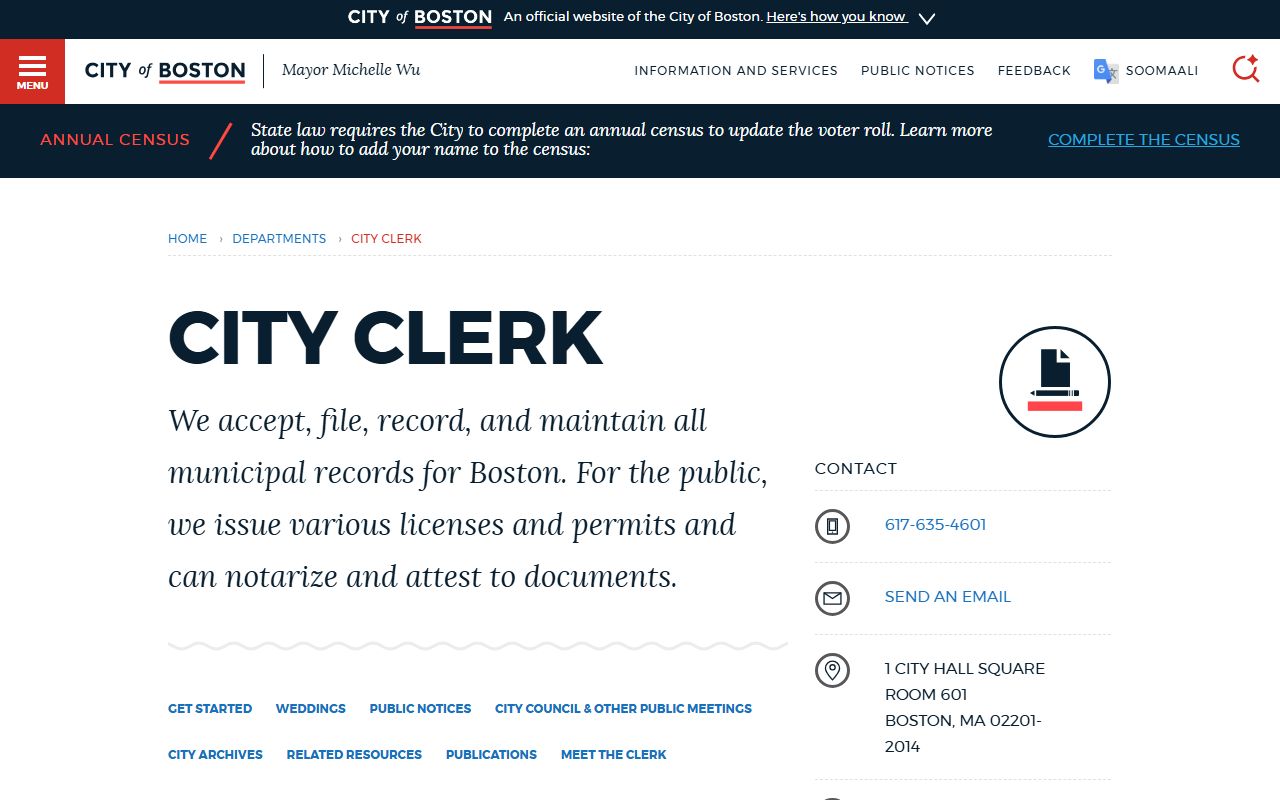
The clerk's portal is one of several ways to request public records from the City of Boston without visiting in person.
For police-specific records, use the Boston Police Department's own records request process. The BPD's records page at boston.gov/departments/police explains what types of reports are available, how to submit a request, and what the copy fees are. The screenshot below shows the BPD's online presence.
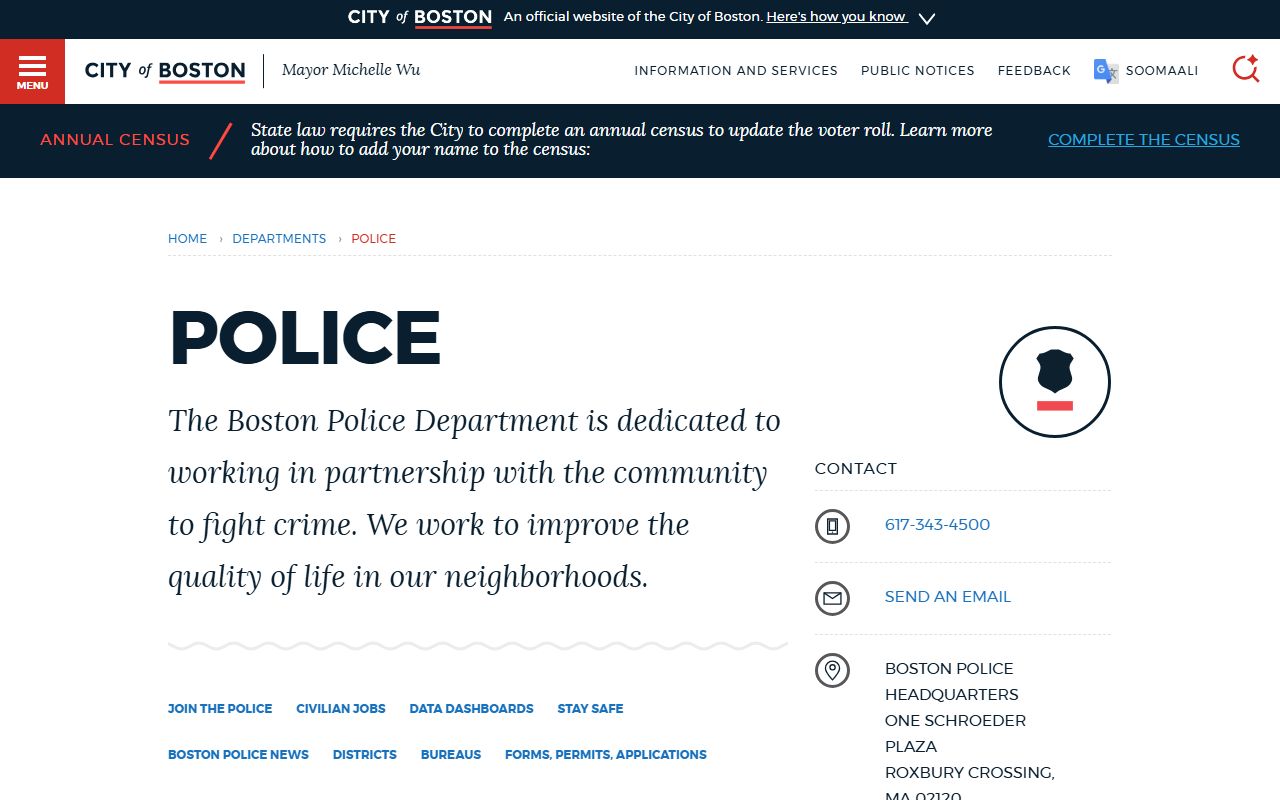
The BPD site is the starting point for police record requests in Boston.
Nearby Cities
Other cities near Boston that also have criminal history pages include Cambridge, Somerville, Quincy, Revere, Malden, and Everett.
Suffolk County Criminal History Records
Boston is the county seat of Suffolk County. All criminal cases filed in Boston courts are part of the Suffolk County court system. The county page has more detail on the full range of courts, clerks, and agencies that handle criminal history records across Suffolk County, including Chelsea, Revere, and Winthrop.